Is Nvidia a video game company? A chip maker? An AI company? And who actually buys what it makes, gamers or the giants of the cloud?
In this article we'll see what Nvidia sells in plain words, who pays for it and how much is left at the end. Every number comes from the reports it files with the SEC: ten minutes here, instead of an evening on the annual report.
Here's where we're going, Nvidia in one table:
| Quarter ended October 25, 2026 | |
|---|---|
| Revenue | $115.8 billion, +103% year over year |
| From Data Center | 92.9% |
| From Edge Computing (PCs, gaming, workstations, cars, robots) | 7.1% |
| From customers headquartered in the United States | 62.9% |
| From the 3 direct customers at 10% or more each | 36% |
| Gross margin | 74.8% |
| Operating margin | 66.9% |
As of the Form 8-K with the results for the quarter ended October 25, 2026, filed on November 17, 2026. The Form 10-Q for the same quarter isn't out yet.
If you only want the numbers, jump to "Who pays". If you already know what a GPU is, skip to "How the money comes in".
The need
If you own an index fund on US stocks, you own some Nvidia: it's in both the S&P 500 and the Nasdaq-100. It often happens that a company enters your savings before you know what it does.
With Nvidia everybody has an answer, and each answer has a different age. Ask a gamer: "it makes graphics cards". Read the headlines: "it makes AI chips". Open the annual report: "NVIDIA is now a data center scale AI infrastructure company reshaping all industries." True. And not much help.
What if we could explain Nvidia the way we'd explain it to a friend at dinner, and then check every sentence against real numbers?
Luckily, we don't have to trust anybody's opinion. Every American listed company has to write down, four times a year, what it sells, to whom and for how much. One annual report and three quarterly ones: the 10-K and the 10-Q.
Before each report, the company announces its results in a third form, the 8-K. Nvidia usually files the two on the same day. Not this time: the 10-Q is promised "in the coming weeks", so this quarter's figures come from the 8-K.
One warning before we start: Nvidia's year isn't the calendar year. Its fiscal year ends on the last Sunday of January and takes the name of the year in which it ends. So "fiscal 2026" ended on January 25, 2026, and the quarter that ended on October 25, 2026 is the third quarter of fiscal 2027.
What Nvidia sells: from one chip to the whole kitchen
Imagine a restaurant kitchen. A traditional processor, the CPU, is like one excellent chef. He can cook anything, one dish at a time. Fine for a table of four.
Now the order is ten thousand identical plates. What's wrong with our chef? Nothing, but he's the wrong tool. What you want is a brigade of thousands of cooks, each doing one simple step, all at the same moment. That brigade is the chip Nvidia, according to its annual report, invented in 1999: the graphics processing unit, or GPU.
Why "graphics"? Because the first job of that kind was drawing a video game: millions of points on a screen to compute at once, many times a second. Then came a second job. In 2012, the annual report recalls, a neural network trained on Nvidia GPUs won a famous image-recognition competition. Same brigade, new menu.
Today Nvidia doesn't sell only the brigade. It sells the whole kitchen, designed as one piece. According to the annual report for fiscal 2026, its platforms address four markets:
- Data Center is the kitchen at industrial scale: GPUs, Nvidia's own CPUs, the networking that lets hundreds of thousands of GPUs "function as a single giant computer", and the software to run it all. It's typically delivered as "rack-scale systems, subsystems, or modules", that is whole cabinets of equipment or parts of them. The networking arrived in 2020 with the acquisition of Mellanox.
- Gaming is where it all started: GeForce graphics cards for desktop and laptop PCs, the GeForce NOW cloud gaming service, and chips for game consoles.
- Professional Visualization is the same technology for work: RTX PRO graphics cards for the workstations used in design, engineering and digital content creation.
- Automotive is the DRIVE platform, the computer and the software for assisted and self-driving cars.
Under all four there's a layer you can't touch: CUDA, the software that lets a programmer give orders to the brigade, introduced in 2006. In our kitchen it would be the recipe book every cook already knows by heart. The annual report counts over 7.5 million developers using CUDA and Nvidia's other software tools, and says that more than half of Nvidia's engineers work on software.
The kitchen is my example, not the filing's. The products and the dates are the annual report's.
Sure, four markets look like four businesses. But the report insists on the opposite: all four run on "a unified underlying architecture". One brigade, four dining rooms.
One more thing: Nvidia doesn't manufacture what it sells. It designs. Foundries such as TSMC and Samsung produce the chips, SK Hynix, Micron and Samsung supply the memory, and contract manufacturers such as Hon Hai, Wistron and Fabrinet assemble and test the products. Technically it's called a fabless company, that is one without fabrication plants. Of about 42,000 employees at the end of fiscal 2026, 31,000 worked in research and development.
One change at the top, because it's in the filings. Jensen Huang (Jen-Hsun Huang in the filings) co-founded Nvidia in 1993 and, according to the annual report for fiscal 2026, had been its President, CEO and a director since the start. On November 11, 2026, the board accepted his resignation from all three roles, effective immediately. It appointed the Chief Financial Officer, Colette Kress, as interim CEO while it searches for a new one; she keeps the CFO role. Harvey C. Jones, a director since 1993, became Chair of the Board. That's what the Form 8-K filed the next day says, and I'll stop where it stops.
How the money comes in: sales, not subscriptions
Does Nvidia rent out its chips, or charge a monthly fee like a software company? No. The annual report settles it in one line: "We derive our revenue primarily from product sales including hardware and systems."
The mechanics are those of a shop. Nvidia books the revenue when the product passes to the customer, and payment is "generally due shortly after delivery".
And the software? Part of it travels with the hardware, "as an integral part" of the platform. Part is sold on its own, like the licenses for NVIDIA AI Enterprise. The reports don't say how much either brings in. One number gives the scale. At January 25, 2026, contracts longer than one year still had $2.3 billion of revenue to be recognized, against $215.9 billion of revenue in the year.
A subscription renews. A chip has to be sold again.
Who pays: direct and indirect customers
The filings use two words here. A direct customer buys from Nvidia. Often it isn't the final user: it's a company that builds servers or graphics cards around Nvidia's chips, or a distributor. Cloud providers and AI labs can buy directly too. An indirect customer buys Nvidia's products through a direct one: cloud providers again, the smaller AI clouds the reports call "neoclouds", AI labs, enterprises and public bodies.
In our kitchen, the direct customer is often the fitter who installs the kitchen. The indirect customer is the restaurant that cooks in it.
How concentrated is this revenue? Very. Here are the direct customers that made 10% of revenue or more, period by period:
| Period | Direct customers at 10% or more of revenue | Together |
|---|---|---|
| Quarter ended October 25, 2026 | 14%, 11% and 11% | 36% |
| Nine months ended October 25, 2026 | 13%, 12%, 12% and 11% | 48% |
| Fiscal 2026 | 22% and 14% | 36% |
| Fiscal 2025 | 12%, 11% and 11% | 34% |
| Fiscal 2024 | 13% | 13% |
Direct customers only. The last column is my sum. The reports don't name these customers. They give one link: the 13% customer of fiscal 2024 is one of the two at 11% in fiscal 2025.
Who are they? The filings don't say. The annual report for fiscal 2025 called them "Direct Customer A", "B" and "C". The latest reports only count them: "three direct customers", "four direct customers".
Nvidia estimates that a limited number of indirect customers weigh heavily too, "some individually representing 10% or more" of revenue. And that "one AI research and deployment company", unnamed, contributed a meaningful amount of revenue by buying cloud services from Nvidia's customers.
In the first nine months of fiscal 2027, four buyers made almost half of Nvidia's revenue.
What they buy: two platforms, two segments
Since fiscal 2027 the reports speak of two "market platforms": Data Center and Edge Computing, that is the devices outside the data center, "including PCs, game consoles, workstations, AI-RAN base stations, robotics and automotive".
What happened to the four markets? Nvidia only says that it changed the presentation and recast the past. The recast figures show the rest: Data Center is the old Data Center, and Edge Computing matches, quarter by quarter in fiscal 2026, the sum of the other lines: Gaming, Professional Visualization, Automotive and a small "OEM and Other".
| Market platform | Revenue | Share | Year over year |
|---|---|---|---|
| Data Center | $107.6 billion | 92.9% | +110% |
| of which Hyperscale | $60.1 billion | about 52% | +71% |
| of which AI Clouds, Industrial, & Enterprise | $47.5 billion | about 41% | +195% |
| Edge Computing | $8.2 billion | 7.1% | +42% |
| Total | $115.8 billion | 100% | +103% |
Quarter ended October 25, 2026. The filing gives these lines in billions; the shares are computed on those rounded figures.
Who's inside Data Center? Hyperscale is "the public clouds and the world's largest consumer internet companies". The second line is everybody else who builds data centers for AI: specialized AI clouds, companies and governments. Hyperscale is the larger half, about 56% of Data Center revenue. The other half is growing faster.
The accounting notes cut the same revenue a second way, into two reportable segments. Compute & Networking "includes" the Data Center computing and networking platforms, the AI software and the automotive platforms: $106.0 billion in the quarter, about 91.5% of revenue, +108% year over year. Graphics includes the GeForce GPUs for gaming and PCs and the GPUs for workstations: $9.8 billion, about 8.5%, +62%.
Watch out: the two cuts don't nest. Data Center, at $107.6 billion, is larger than the whole Compute & Networking segment, so part of it is counted outside that segment. Different cuts, same picture: in both, the largest piece is more than nine tenths of revenue.
Where the customers are: headquarters, not destinations
The same revenue, cut by country:
| Region | Revenue | Share |
|---|---|---|
| United States | $72.9 billion | 62.9% |
| Taiwan | $30.3 billion | 26.2% |
| China (including Hong Kong) | $11.1 billion | 9.5% |
| Other | $1.6 billion | 1.4% |
Quarter ended October 25, 2026. A customer's country is where the direct customer's headquarters is.
Is Taiwan really buying a quarter of Nvidia's chips for itself? No. Taiwan is where many server builders have their headquarters. They buy from Nvidia, assemble and ship elsewhere. The annual report gives an estimate: in fiscal 2026, 76% of the Data Center revenue from Taiwan-headquartered customers was attributed to end customers in the United States and Europe.
The filing itself puts the warning right above the table: "The end customer and shipping location may be different from our direct customers' headquarters location." This table tells you who signs the order, not where the chips end up.
How the mix changed over the years
One quarter is a photo. Let's look at the film:
| Period | Revenue | Data Center | Gaming | Professional Visualization | Automotive | OEM and Other | The last four together |
|---|---|---|---|---|---|---|---|
| Fiscal 2022 | $26.9 billion | 39.4% | 46.3% | 7.8% | 2.1% | 4.3% | 60.6% |
| Fiscal 2023 | $27.0 billion | 55.6% | 33.6% | 5.7% | 3.3% | 1.7% | 44.4% |
| Fiscal 2024 | $60.9 billion | 78.0% | 17.1% | 2.5% | 1.8% | 0.5% | 22.0% |
| Fiscal 2025 | $130.5 billion | 88.3% | 8.7% | 1.4% | 1.3% | 0.3% | 11.7% |
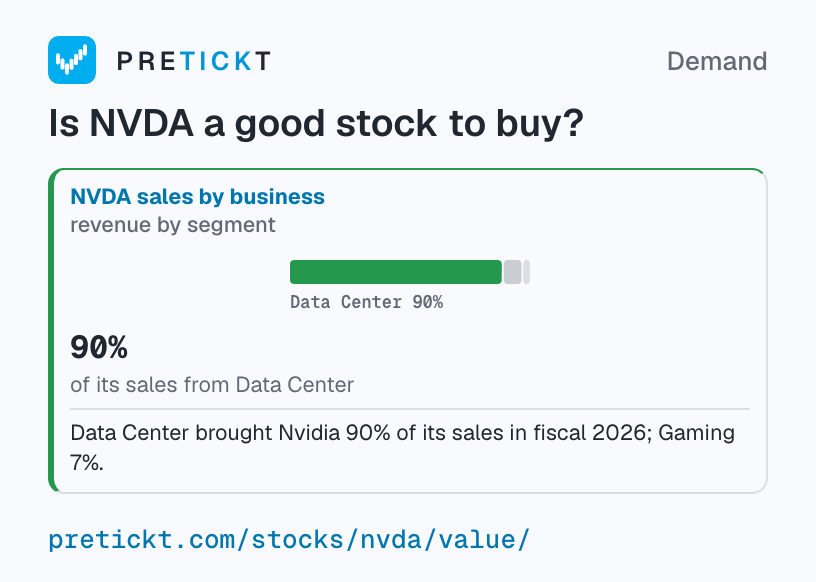
| Fiscal 2026 | $215.9 billion | 89.7% | 7.4% | 1.5% | 1.1% | 0.3% | 10.3% |
| Nine months to October 25, 2026 | $293.7 billion | 92.6% | – | – | – | – | 7.4% |
Fiscal 2022 ended on January 30, 2022, fiscal 2026 on January 25, 2026. The nine-month shares are approximate: the third quarter is given in billions.
In fiscal 2022 gaming was still Nvidia's largest market: Gaming made 46.3% of revenue, Data Center 39.4%. Four years later the proportions are unrecognizable: Data Center 89.7%, Gaming 7.4%.
Did gaming shrink, then? No. Gaming revenue grew 29% between fiscal 2022 and fiscal 2026, from $12.5 billion to $16.0 billion. Over the same four years Data Center revenue multiplied by 18.3, from $10.6 billion to $193.7 billion, and total revenue by 8.0. Gaming didn't get smaller. Everything around it got enormous.
Inside Data Center, the annual report separates the processors from the networking, that is the cables and switches that connect them:
| Fiscal year | Data Center compute | Data Center networking | Networking share |
|---|---|---|---|
| Fiscal 2024 | $39.0 billion | $8.6 billion | 18.0% |
| Fiscal 2025 | $102.2 billion | $13.0 billion | 11.3% |
| Fiscal 2026 | $162.4 billion | $31.4 billion | 16.2% |
Networking alone, $31.4 billion in fiscal 2026, is larger than the whole of Nvidia was in fiscal 2022. In two years it multiplied by 3.7.
And the countries? Here the film is shorter, three years plus the current one. I'll explain why in a moment.
| Period | United States | Taiwan | China (including Hong Kong) | Other |
|---|---|---|---|---|
| Fiscal 2024 | 51.8% | 24.5% | 20.2% | 3.5% |
| Fiscal 2025 | 59.4% | 18.1% | 19.2% | 3.3% |
| Fiscal 2026 | 69.3% | 19.6% | 9.1% | 2.0% |
| Nine months to October 25, 2026 | 67.0% | 23.6% | 8.0% | 1.4% |
By the location of the direct customer's headquarters.
Two movements. Customers headquartered in the United States went from 51.8% to 69.3% of revenue between fiscal 2024 and fiscal 2026, then 67.0% in the first nine months of fiscal 2027. Customers headquartered in China went from 20.2% to 9.1%, then 8.0%.
What's left at the end: three numbers
Three numbers are enough here. What's left out of every $100 of revenue after the cost of making the products is the gross margin. What's left after research and the other costs of running the business is the operating margin. What's left for shareholders after taxes is net income.
In the quarter ended October 25, 2026, Nvidia kept $74.80 out of every $100 after the cost of its products, and $66.90 after all operating costs: $77.5 billion of operating income on $115.8 billion of revenue. Net income was $65.3 billion. The distance between the two is mostly income tax: $13.7 billion, 17.4% of the profit before tax.
Was it always this rich? Let's see:
| Period | Gross margin | Operating income | Operating margin | Net income |
|---|---|---|---|---|
| Fiscal 2022 | 64.9% | $10.0 billion | 37.3% | $9.8 billion |
| Fiscal 2023 | 56.9% | $4.2 billion | 15.6% | $4.4 billion |
| Fiscal 2024 | 72.7% | $33.0 billion | 54.1% | $29.8 billion |
| Fiscal 2025 | 75.0% | $81.5 billion | 62.4% | $72.9 billion |
| Fiscal 2026 | 71.1% | $130.4 billion | 60.4% | $120.1 billion |
| Nine months to October 25, 2026 | 74.9% | $194.8 billion | 66.3% | $183.3 billion |
GAAP figures, the unadjusted ones.
Look at fiscal 2023. Revenue was flat, and the operating margin fell to 15.6%. The annual report names two reasons: $2.17 billion of inventory charges and $1.35 billion written off when the acquisition of Arm was abandoned. The smaller step back in fiscal 2026 has two causes as well: the move to selling complete data center systems, and a $4.5 billion charge on H20, a chip that suddenly needed a license to be exported to China. We'll come back to it.
Sure, a company that keeps two dollars out of every three looks unbreakable. But fiscal 2023 ended less than four years ago.

And where does the profit go? In the same quarter Nvidia returned $28.1 billion to its shareholders: $22.1 billion of share buybacks and $6.0 billion of dividends. A dividend of this size is new: on May 18, 2026, Nvidia raised it from $0.01 to $0.25 per share each quarter.
Both amounts are per share after the 10-for-1 split of June 2024; what a split changes, and what it doesn't, is in what happens after a stock split. Revenue and margins quarter by quarter are on pretickt's Nvidia financials page, and the payment dates on its Nvidia dividend page.
What experience will teach you
You'll learn that a geography table is only as good as its definition. Until the third quarter of fiscal 2026, Nvidia assigned revenue to the customer's billing location, and Singapore showed up with 18% of fiscal 2025 revenue. Did Singapore buy all those chips? No. Customers used it "to centralize invoicing", and shipments to Singapore were less than 2% of revenue. Then Nvidia switched to the customer's headquarters and recast the past only back to fiscal 2024. For the same fiscal 2025, revenue from outside the US was 53% by billing location and 41% by headquarters. My advice: before you compare two years, read the title of the table.
You'll meet two different numbers for China, and it's easy to mix them. The geography table says $11.1 billion in the quarter, 9.5% of revenue: that's every product sold to customers with their headquarters in China or Hong Kong, wherever it was shipped. The commentary on the same quarter says that shipments of Data Center "Hopper" products to China were $2.4 billion, about 2% of Data Center revenue. And for the next quarter Nvidia is "not assuming any Data Center compute revenue from China".
Why so cautious? Since 2022 the US government requires licenses to export some of Nvidia's data center chips to China, and the rules keep changing. In April 2025 a new requirement hit the H20 chip: that's the $4.5 billion charge we saw above. The annual report for fiscal 2026 says Nvidia was "effectively foreclosed" from China's data center market, and the first half of fiscal 2027 brought another charge, $0.4 billion, on the H200 chip.
You'll also discover that a company without factories isn't a company without obligations. To secure chips, memory and capacity, Nvidia promises its suppliers future purchases: $390 billion at October 25, 2026, up from $279 billion three months earlier and $95.2 billion in January. For scale, its revenue over the last twelve months was $361.8 billion. With cloud services, leases, investments and equipment, the commitments reach $518 billion. Beside them sit $32 billion of agreements with neoclouds that take effect only under certain conditions, and guarantees of up to $118.0 billion, $105.0 billion of it on a single data center campus in Ohio. Some agreements can be rescheduled or canceled, the reports say, but changes "may result in additional costs". I'd read this table every quarter, right after revenue.
Watch the last line too. Net income includes the gains on Nvidia's investments in other companies: $25.5 billion in the first nine months of fiscal 2027, most of them unrealized, that is on paper. That's why I look at the operating margin first. Nvidia also publishes "non-GAAP" figures. Since fiscal 2027 they no longer leave out the pay in shares ($2.1 billion in the quarter), so the gap is small: $77.9 billion of non-GAAP operating income against $77.5 billion. Every number in this article is the unadjusted one.
There's one question these tables can't answer, though: whether the stock is cheap or expensive. They tell you what the business is. They don't tell you what it's worth.
Conclusions
We've seen what Nvidia sells, one brigade of cooks grown into a whole kitchen, who pays for it, where those customers have their headquarters and how much is left at the end.
A company is what its customers pay for this year, not what made it famous.
Here's an exercise for the next report. When the Form 10-Q for this quarter arrives, open the note called "Segment Information" and check three numbers against this article: the Data Center share, the direct customers above 10% and the US share. One caution for the quarter after that: fiscal 2027 is a 53-week year, so its fourth quarter has 14 weeks instead of 13. Then try the same note on another company you follow. The method doesn't change.
What you won't find in a filing is the price. Nvidia's live price, the analysts' price targets, the next earnings date and the companies it's compared with are on pretickt's Nvidia (NVDA) page.

Frequently asked questions
What does Nvidia do?
Nvidia designs graphics processing units (GPUs) and the systems built around them: chips that do a huge number of simple calculations at once, first used for video games and today sold mostly to data centers, where they train and run artificial intelligence. It sells complete data center systems with networking and software (the CUDA platform), graphics cards for gaming PCs and workstations, and computers for cars. In the quarter ended October 25, 2026, 92.9% of its revenue came from data centers.
How does Nvidia make money?
Nvidia makes money by selling hardware, not subscriptions. Its annual report says revenue comes "primarily from product sales including hardware and systems", booked when the product passes to the customer; software comes as part of the platform or under separate licenses. Its direct customers are server builders, distributors and cloud providers. In the quarter ended October 25, 2026, Nvidia kept $66.90 of operating income out of every $100 of revenue, a GAAP operating margin of 66.9%.
What is Nvidia's revenue?
Nvidia's revenue was $115.8 billion in the quarter ended October 25, 2026, the third quarter of its fiscal 2027, up 103% year over year, and $293.7 billion in the first nine months of that fiscal year. In the last full fiscal year, fiscal 2026 (ended January 25, 2026), it was $215.9 billion, against $26.9 billion in fiscal 2022. Over the twelve months to October 25, 2026, revenue was $361.8 billion. The figures come from Nvidia's results for the quarter, filed with the SEC on November 17, 2026, and from its annual reports.
What are Nvidia's main business segments?
Nvidia reports two segments: Compute & Networking and Graphics. Compute & Networking includes the data center computing and networking platforms, AI software and automotive; Graphics includes the GPUs for gaming, PCs and workstations. In the quarter ended October 25, 2026, Compute & Networking brought in $106.0 billion, about 91.5% of revenue, and Graphics $9.8 billion. Nvidia also splits its revenue by market platform, a separate cut that doesn't nest with the segments: Data Center ($107.6 billion) and Edge Computing ($8.2 billion).
What is Nvidia's biggest source of revenue?
Nvidia's biggest source of revenue is the data center: 92.9% of revenue in the quarter ended October 25, 2026, that is $107.6 billion out of $115.8 billion. It wasn't always so: in fiscal 2022 gaming was Nvidia's largest market, with 46.3% of revenue against 39.4% for the data center.
What is Nvidia's revenue breakdown by region?
By the headquarters of its direct customers, 62.9% of Nvidia's revenue came from the United States in the quarter ended October 25, 2026, 26.2% from Taiwan, 9.5% from China including Hong Kong and 1.4% from other countries. These are the places where the buyers have their head office, not where the chips end up: Nvidia estimates that in fiscal 2026, 76% of its Data Center revenue from Taiwan-headquartered customers was attributed to end customers in the United States and Europe.
Who is Nvidia's biggest competitor?
Nvidia's annual report doesn't single out one biggest competitor: it lists groups of them. For GPUs and other AI chips it names AMD, Huawei and Intel. It also names large cloud companies that design their own chips, such as Alibaba, Alphabet, Amazon, Baidu, Huawei and Microsoft, although the same report says that all major cloud providers use Nvidia's platforms. In networking it names, among others, Arista Networks, Broadcom and Cisco. The list is in Nvidia's Form 10-K for fiscal 2026.
What is the history of Nvidia?
Nvidia was incorporated in California in April 1993, and reincorporated in Delaware in April 1998. According to its annual report it invented the GPU in 1999, opened it to work beyond graphics with the CUDA software in 2006 and added networking with the acquisition of Mellanox in 2020. In fiscal 2022 gaming was still Nvidia's largest market; by fiscal 2026 the data center made 89.7% of revenue. On November 11, 2026, co-founder Jensen Huang resigned as President, CEO and board member, and the board appointed CFO Colette Kress as interim CEO.
Does Nvidia pay dividends?
Yes, Nvidia pays a quarterly cash dividend. On May 18, 2026, Nvidia raised it from $0.01 to $0.25 per share, and the next payment is on December 23, 2026, to shareholders of record on December 2, 2026. In the quarter ended October 25, 2026, Nvidia paid $6.0 billion of dividends and spent $22.1 billion on share buybacks. Each future dividend is decided by the Board of Directors.