Is Palantir a defense contractor? A data company? An AI company? And who actually pays it, governments or businesses?
In this article we'll see what Palantir sells in plain words, who pays for it and how much is left at the end. Every number comes from the reports it files with the SEC: ten minutes here, instead of an evening on the annual report.
Here's where we're going, Palantir in one table:
| Quarter ended September 30, 2026 | |
|---|---|
| Revenue | $2,313.4 million, +96% year over year |
| From government customers | 49.5% |
| From commercial customers | 50.5% |
| From the United States | 83.7% |
| From the rest of the world | 16.3% |
| Customers | 1,090 |
| Operating margin | 46.9% |
As of the Form 10-Q for the quarter ended September 30, 2026, filed on November 3, 2026.
If you only want the numbers, jump to "Who pays". If you already know the four platforms, skip to "How the money comes in".
The need
It often happens that a stock enters your life before you know what the company does. It's in the headlines, in the index fund you own, in a friend's group chat. With some companies three words are enough: Apple sells phones.
With Palantir it's harder. Ask three people and you'll get three answers: "it works for the military", "it does big data", "it's an AI stock". The company's own annual report doesn't settle it either: "We build software that empowers organizations to effectively integrate their data, decisions, and operations at scale." True. And not much help.
What if we could explain Palantir the way we'd explain it to a friend at dinner, and then check every sentence against real numbers?
Luckily, we don't have to trust anybody's opinion. Every American listed company has to write down, four times a year, what it sells, to whom and for how much. One annual report and three quarterly ones: the 10-K and the 10-Q.
What Palantir sells: one picture of the whole organization
Imagine a supermarket chain. Stock levels live in one system, deliveries in another, the cash registers in a third, staff shifts in a spreadsheet. Each one works fine on its own.
The trouble starts when a question crosses them. A truck is late: which stores will run out of milk tomorrow, and who is on shift to fix it? The simple solution is a person who exports four files and merges them by hand. What's wrong with it? It's slow, and by morning the answer is old.
Now suppose all four systems fed a single, always up-to-date picture of the company: stores, trucks, orders and people, linked to each other. That picture is what Palantir sells. In its reports it has a name: the Ontology.
Around this idea Palantir has built what it calls its four principal software platforms:
- Foundry is where the picture is built, a sort of central operating system for an organization's data. According to the annual report, all of Palantir's commercial customers use it, and many government customers too.
- Gotham is the same idea for defense and intelligence: data from many sources and sensors on one screen, for the people who plan a mission. It's where Palantir started: founded in 2003, it built its first software for the US intelligence community.
- AIP, the Artificial Intelligence Platform, connects large language models, the technology behind chatbots, to that picture. In our supermarket it would be an assistant that knows your stores and trucks, proposes "move 200 crates from store A to store B" and waits for a person to approve. Palantir began deploying it in 2023.
- Apollo is the delivery layer. It installs and updates the other three wherever the customer runs them: "in the cloud, on-premises, or even more rugged environments". Think of your phone's automatic updates, for systems that have to keep running.
The supermarket is my example, not a customer. Among real users the annual report lists automotive manufacturing workers and pharmaceutical researchers in the United States, supply-chain managers in South Korea, public health administrators in the United Kingdom, and military personnel.
Sure, four names look like four products. But customers can bundle them, and the reports never say how much revenue each one brings in. One idea, four names.
How the money comes in: subscriptions, not one-off sales
Does Palantir sell its software once, like a program in a box? No. According to its reports, revenue comes from three sources:
- Palantir Cloud: a subscription to the software, hosted by Palantir;
- On-Premises Software: a subscription to the software running on the customer's own machines or cloud;
- Professional services: support, training, configuration and data modeling.
In all three cases the customer pays for a period, generally one to five years, and Palantir books the revenue a little at a time. The reports don't split revenue across the three.
How does a new customer start? Often with a pilot or a "bootcamp", a few days of work on the customer's real data, which Palantir runs "generally at our own expense and without a guarantee of future returns". The bet is that the customer stays and grows.
How many pilots turn into paying contracts? The filings don't say. What they do say is where the growth comes from:
In the quarter ended September 30, 2026, commercial revenue grew by $619 million year over year, and $407 million of that came from customers Palantir already had at the end of 2025. For government customers it was $484 million out of $513 million.
Most of the growth came from customers Palantir already had.
Who pays: governments and companies
Palantir splits its customers into two groups. On one side government agencies, American or not. On the other everybody else, that is companies. In the reports these are its two segments: Government and Commercial.
| Segment | Revenue | Share | Year over year |
|---|---|---|---|
| Government | $1,145.5 million | 49.5% | +81% |
| Commercial | $1,167.9 million | 50.5% | +113% |
| Total | $2,313.4 million | 100% | +96% |
Quarter ended September 30, 2026 (Form 10-Q filed on November 3, 2026).
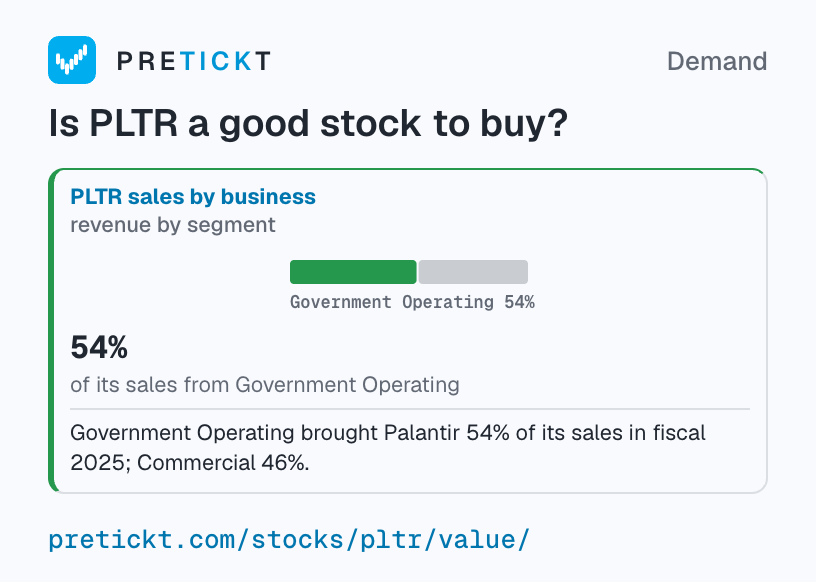
Is Palantir a government contractor, then? Half of it. In this quarter the two halves are almost equal, with companies slightly ahead.
Watch the word "government", though. It doesn't mean "US government": of those $1,145.5 million, $953 million came from US government customers and the rest from other countries' agencies.
Where the customers are: the United States and the rest of the world
The same revenue, cut by country:
| Region | Revenue | Share |
|---|---|---|
| United States | $1,937.2 million | 83.7% |
| Rest of world | $376.2 million | 16.3% |
Quarter ended September 30, 2026. A customer's country is where its headquarters or agency is. In this quarter, as in the first nine months of 2026, no single country outside the US reaches 10% of revenue.
Let's cross the two tables. We get four boxes:
- US companies: $984 million, about 43% of revenue;
- US government: $953 million, about 41%;
- governments outside the US: about $193 million, about 8%;
- companies outside the US: about $184 million, about 8%.
More than four dollars out of five come from the United States, split almost evenly between the government and private companies.
How the mix changed over the years
One quarter is a photo. Let's look at the film:
| Period | Revenue | Government | Commercial | United States | Outside the US | Customers |
|---|---|---|---|---|---|---|
| 2021 | $1.54 billion | 58.2% | 41.8% | 57.0% | 43.0% | 237 |
| 2022 | $1.91 billion | 56.2% | 43.8% | 60.9% | 39.1% | 367 |
| 2023 | $2.23 billion | 54.9% | 45.1% | 61.9% | 38.1% | 497 |
| 2024 | $2.87 billion | 54.8% | 45.2% | 66.3% | 33.7% | 711 |
| 2025 | $4.48 billion | 53.7% | 46.3% | 74.2% | 25.8% | 954 |
| January to September 2026 | $5.88 billion | 50.9% | 49.1% | 81.5% | 18.5% | 1,090 |
Fiscal years end on December 31. "Outside the US" is total revenue minus US revenue. From 2021 to 2025 the United Kingdom alone was about 10% to 12% of revenue ($427 million in 2025); in the first nine months of 2026 no country outside the US reaches 10%. As of the Form 10-K for fiscal 2025 and the Form 10-Q for the quarter ended September 30, 2026.
Two movements, at two different speeds. The government share goes down slowly: from 58.2% in 2021 to 50.9% in the first nine months of 2026. The US share goes up fast: from 57.0% to 81.5%.
Is the business outside the US shrinking, then? No. Revenue from outside the US grew 74% between 2021 and 2025, from $663 million to $1,155 million. Over the same four years US revenue multiplied by 3.8. The business outside the US grew. The US grew much faster.
How many customers, and how concentrated
Palantir had 1,090 customers at September 30, 2026, against 911 a year earlier. Is its revenue spread evenly among them? Not quite. Here's what the 10-Q says about the biggest ones:
- no single customer makes more than 10% of revenue;
- the top three together made 16% of revenue in the first nine months of 2026, as in 2025 (17% in 2024);
- the top twenty brought in $146 million each on average over the last twelve months, up from $83 million a year earlier.
Twenty times $146 million is about $2.9 billion, and over those twelve months revenue was $7.29 billion. So yes, more than a thousand customers. But twenty of them bring in about 40 cents of every dollar.
What's left at the end: two numbers
Two numbers are enough here. The first is how much is left out of every $100 of revenue after the costs of running the business: the operating margin. The second is what's left for shareholders after interest and taxes: net income.
In the quarter ended September 30, 2026, Palantir kept $46.90 out of every $100: $1,084.8 million of income from operations on $2,313.4 million of revenue. Net income was $1,128.0 million. Why is it higher than the operating figure? Mostly because Palantir earned $88.9 million of interest on its cash and investments, against $13.6 million of income taxes.
Why so little tax? Palantir made losses for years, and the shares it pays its employees give it large tax deductions. So in the US it still has tax losses to use, about $9.0 billion of federal ones at the end of 2025, and the tax line is mostly foreign and state taxes.
It wasn't always like this:
| Period | Income from operations | Operating margin | Net income |
|---|---|---|---|
| 2021 | −$411.0 million | −26.7% | −$520.4 million |
| 2022 | −$161.2 million | −8.5% | −$373.7 million |
| 2023 | $120.0 million | 5.4% | $209.8 million |
| 2024 | $310.4 million | 10.8% | $462.2 million |
| 2025 | $1,414.0 million | 31.6% | $1,625.0 million |
| January to September 2026 | $2,750.8 million | 46.8% | $3,060.4 million |
GAAP figures; net income is the part attributable to common stockholders. As of the Form 10-K for fiscal 2025 and the Form 10-Q for the quarter ended September 30, 2026.
In 2021 Palantir lost 27 cents on every dollar of revenue. In 2026, so far, it keeps 47.

Revenue and margins quarter by quarter are on pretickt's Palantir financials page.
What experience will teach you
You'll learn that Palantir publishes two operating profits. For the quarter ended September 30, 2026, the 10-Q shows $1.1 billion of income from operations and $1.4 billion of "adjusted" income from operations. The gap is mostly pay in shares: $318.9 million of stock-based compensation in the quarter, a cost the adjusted figure leaves out. Every number in this article is the unadjusted one. My advice: before you trust a headline, check which of the two it quotes.
You'll also meet two different numbers for "contracts signed". The larger one is the total remaining deal value: $11.2 billion at December 31, 2025. It assumes every option is exercised and no contract is terminated, and it leaves out $12.3 billion of government contracts whose funding isn't decided yet (IDIQ contracts, in the jargon). It's a year-end figure. The 10-Q doesn't update it, and the press release for the same quarter gives only the US commercial part, $6.517 billion. The stricter measure, which leaves out what a customer can cancel, was $4.1 billion at the end of 2025 and $4.9 billion at September 30, 2026: the remaining performance obligations. Why such a gap? Many customers can terminate with less than twelve months' notice.
The customer count has a catch too. Palantir counts every agency with its own contract as a separate customer: the FDA, the CDC and the NIH are three customers, although all three belong to the same US department. I'd avoid comparing this number with another software company's.
There's one question these tables can't answer, though: whether the stock is cheap or expensive. They tell you what the business is. They don't tell you what it's worth.
Conclusions
We've seen what Palantir sells, one live picture of an organization under four names, who pays for it, where those customers are and how much is left at the end.
A company is what its customers pay for, not what the headlines call it.
Here's an exercise for the next quarterly report. Open the note called "Segment and Geographic Information" and check two numbers against the previous quarter's: the commercial share and the US share. Then try the same note on another company you follow. The method doesn't change.
What you won't find in a filing is the price. Palantir's live price, the analysts' price targets and the next earnings date are on pretickt's Palantir (PLTR) page.

Frequently asked questions
What does Palantir do?
Palantir sells software that joins an organization's separate data systems into a single, always up-to-date picture that people use to make decisions. It comes as four platforms: Foundry for companies and agencies, Gotham for defense and intelligence, AIP to connect large language models to that data, and Apollo to install and update the other three. Founded in 2003, Palantir had 1,090 customers at September 30, 2026, and its revenue is split almost evenly between governments and companies.
How does Palantir make money?
Palantir makes money from subscriptions, not one-off sales. Customers pay for a period, generally one to five years, for the software hosted by Palantir (Palantir Cloud), for the software running on their own machines (On-Premises Software) or for professional services such as training and configuration. New customers often start with a pilot or "bootcamp", generally run at Palantir's own expense. In the quarter ended September 30, 2026, $407 million of the $619 million growth in commercial revenue came from customers Palantir already had.
What is Palantir's revenue?
Palantir's revenue was $2,313.4 million in the quarter ended September 30, 2026, up 96% year over year, and $5.88 billion in the first nine months of 2026. In the last full fiscal year, 2025, it was $4.48 billion, against $1.54 billion in 2021. Over the twelve months to September 30, 2026, revenue was $7.29 billion. The figures come from Palantir's Form 10-Q, filed on November 3, 2026, and from its annual reports.
Is Palantir a government contractor?
Palantir is a government contractor for about half of its business. In the quarter ended September 30, 2026, government customers brought in $1,145.5 million, 49.5% of revenue, and commercial customers $1,167.9 million, 50.5%. "Government" doesn't mean only the US: $953 million came from US government customers and the rest from other countries' agencies. The government share has gone down slowly, from 58.2% of revenue in 2021 to 50.9% in the first nine months of 2026.
Where does Palantir's revenue come from?
Most of Palantir's revenue comes from the United States: 83.7% in the quarter ended September 30, 2026, against 16.3% from the rest of the world. By customer, US companies bring in about 43% of revenue, the US government about 41%, governments outside the US about 8% and companies outside the US about 8%. In 2021 the US share was 57.0%. Revenue is also concentrated: over the last twelve months the top twenty customers brought in about 40 cents of every dollar.
Is Palantir profitable?
Palantir is profitable: it has reported a net profit every year since 2023, after losses of $520.4 million in 2021 and $373.7 million in 2022. In the quarter ended September 30, 2026, it had $1,084.8 million of income from operations on $2,313.4 million of revenue, an operating margin of 46.9%, and net income of $1,128.0 million. These are GAAP figures, the unadjusted ones, from the Form 10-Q filed on November 3, 2026.